
Curved building façades, interior linings and landscape-edge walls are increasingly defining design character across New South Wales, particularly in urban residential typologies throughout Sydney. Fibre cement has become a practical choice for achieving these forms thanks to its design flexibility, non-combustibility, dimensional stability and compatibility with both timber and steel framing. However, curved walls demand precise detailing, careful sequencing and strict adherence to minimum bend radii and fastener durability to maintain envelope performance and meet regulatory expectations in NSW approval pathways.
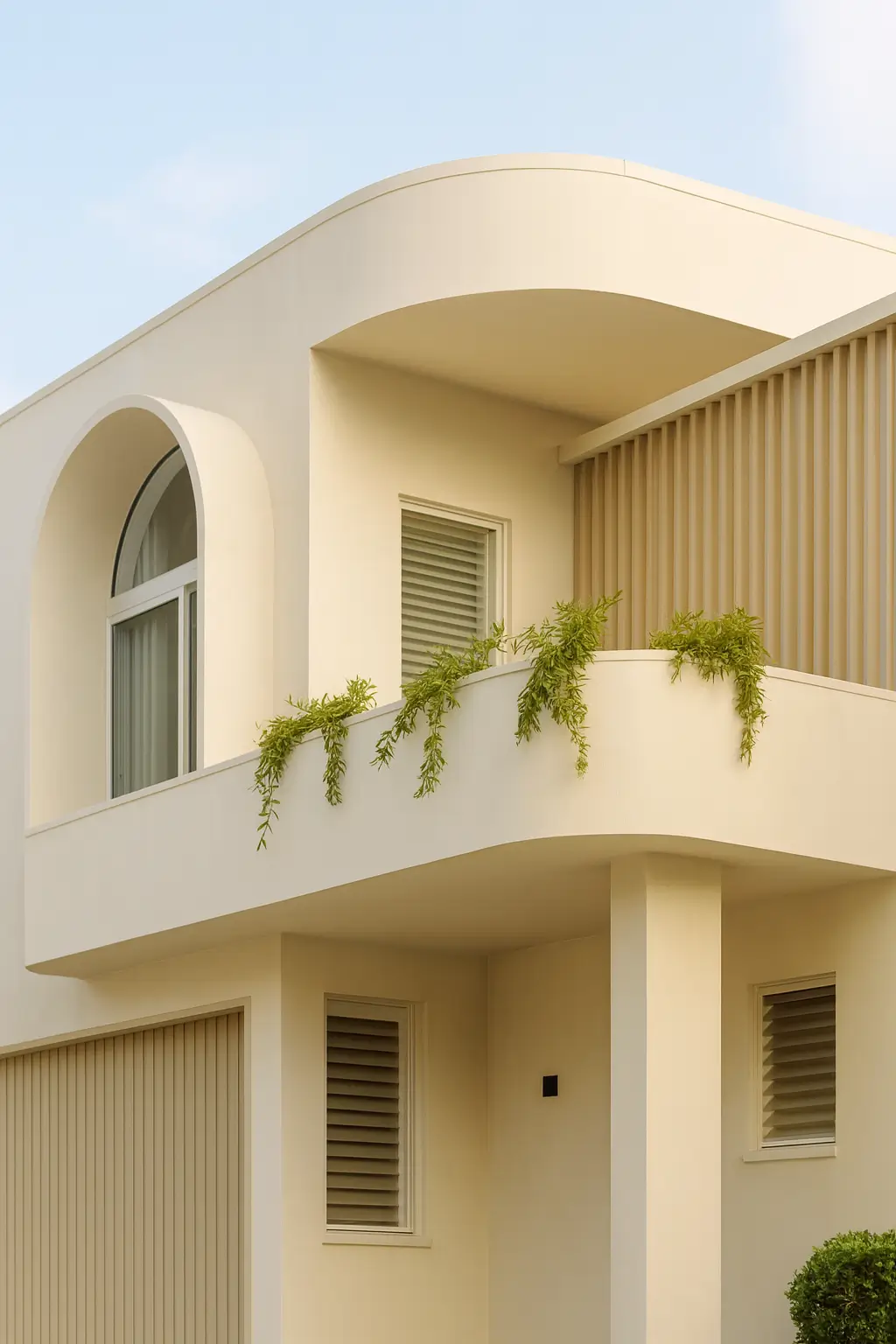
The Role of Curvature in Compliant Building Envelopes
Curved geometry is more than a visual language—it influences performance outcomes including daylight diffusion, façade rhythm, movement flow and apparent spatial widening. The roof-to-wall and wall-to-ground interfaces, when curved, require particular flashing and cavity continuity strategies consistent with the performance requirements of the AS 4055 and the external wet-area provisions of the AS 3740 that apply to residential design. In NSW, envelope documentation is expected to integrate these requirements ahead of submitting through the NSW Planning Portal, especially for local council DA pathways in the Eastern Suburbs, Northern Beaches, Central Coast and Greater Sydney region.
Radius Measurement and Structural Integrity
The supplement confirms all documented installation methods are confined to a maximum residential wind design capability of N3, equivalent to an AS 4055 Wind Design limitation. The curvature radius must be measured from the internal side of the frame to the curve centreline, ensuring cladding maintains mechanical retention, prevents joint widening and minimises moisture ingress risk. Exceeding prescribed radii can compromise joint compression and increase membrane stress.
Minimum Bend Radii (Key Constraints to Embed in Construction Docs)
- Stria™ 325mm Smooth & Fine Texture: 2200mm (convex) / 1800mm (concave) when faceted; 2500mm minimum bend when bent on 6 studs/arcs.
Curved_Walls_Technical_Suppleme… - Stria™ 405mm Boards: 3200mm (convex) / 2000mm (concave) when faceted; 2500mm minimum bend when bent on 6 studs/arcs.
Curved_Walls_Technical_Suppleme… - Hardie™ Oblique™ 200–300mm Boards: 2000mm minimum convex/concave when faceted; 2500mm minimum bend when arc-bent to 6 studs.
Curved_Walls_Technical_Suppleme… - Villaboard™ 6mm Panels: 900mm minimum bend radius when panel-bent (direct fixing) with 350mm max stud spacing and 150mm max fastener spacing.
Curved_Walls_Technical_Suppleme… - Hardie™ Textured Panels (Fine Texture / Brushed Concrete): 1200mm minimum bend, 315mm stud spacing, 125mm fastener centres; heads patched to replicate texture.
Curved_Walls_Technical_Suppleme… - Axon™ Panels: 1500mm minimum bend using 300mm stud/batten spacing and 100mm fastener spacing.
Curved_Walls_Technical_Suppleme…
Note: Brad nails are explicitly discouraged in curved applications due to elevated withdrawal and lateral bending forces.
Fastener Durability, Coastal Zones and Material Compatibility
Across NSW, corrosion exposure is a principal documentation checkpoint. The supplement mandates Class 4 fasteners within 1km of coastal zones or salt-spray-affected microclimates—critically relevant for approvals along the Northern Beaches, Eastern Suburbs and Central Coast. Fasteners must be compatible with adjacent materials, moisture conditions and intended service life.
| Zone Condition | Recommended Specification to Add to Construction Notes |
| Within 1km coast / salt spray / corrosive areas | Class 4 screws or fibre cement nails, heads patched and texture replicated for textured panels |
| High fastener stress due to curvature | Avoid brad nails, select mechanical fasteners per product installation guide |
| Direct fixing to battens/studs | Minimum 2.8 × 40mm wood screws or 2.8 × 40mm fibre cement nails depending on product |
Weather Barrier Sequencing and Joint Support Strategy
Documentation must detail the order of operations clearly to satisfy council review and builder constructability:
- Frame the wall to the intended design radius in facets or continuous arcs, and install the Hardie™ Wrap weather barrier where required.
- Fix 70 × 35mm battens at every vertical joint location to support panel edges and ensure sealant backing integrity.
- Fix the first board or panel strip at one edge using compliant fasteners.
- Apply a continuous 3mm diameter bead of the Hardie™ Joint Sealant along the joint.
- Slowly bend the next board or panel across intermediate studs or battens until the required curvature is achieved, fixing progressively to all supports.
- Leave controlled expansion allowances (3–5mm gaps) between panels/boards depending on method, then repeat sequentially until the curved field is complete.
Controlled gaps, sealant continuity and dedicated joint battens are essential to prevent moisture ingress at curvature transitions and to maintain membrane compression.
Method Selection – Practical Use Cases for NSW Residential Projects
Method 1: Faceting Illusion for Radius Efficiency
Best for tighter radii or when curve precision outweighs complexity. Panels are cut into equal-width strips; smoother curvature = narrower strips = more joints to seal.
Method 2: Direct Panel Bending for Seamless Curves
Ideal for large interior linings or façade panels requiring minimal visual interruption. Requires slower bending, intermediate fixation and 5mm joint gaps at abutments.
Method 3: Wide Board Bending for Repetitive Horizontal Façade Rhythm
Produces a structured curved façade with strong shadow lines. Concealed fixing is not permitted; all fasteners must be face-fixed directly through the board.
Curved fibre cement envelopes, when documented with accurate radii, joint backing strategy, gasket compression, fastener class and membrane sequencing, allow architects and designers to confidently deliver distinctive yet compliant designs to the NSW market. Ensuring these constraints are embedded in drawings and construction notes supports planning approval efficiency, façade longevity, and builder clarity across residential projects in Sydney and surrounding council jurisdictions.ere...